Showing posts with label reading. Show all posts

Oct 25, 2015

What I Learned From the Literacy Summit in Calgary

I just want to start off by saying, my head is full of information and I'm going to try my best to articulate all that I learned these past two days. I attend the Literacy Summit 10 in Calgary put on by the organization Vulnerable Readers. 
This summit had come to my area last year but because of a demand, I was unable to attend. It was a shame because attending it twice would have helped to reinforce what I learned this time around. Regardless, I'm happy I went and here is a brief breakdown of what I learned. 

Richard Allington's Presentation: 
  • Teacher's make the most amount of difference in a student's school career. 
  • Instruction should be support on sound research
  • They can have a positive and negative affect on what a child learns and what a child doesn't learn. 
  • Research shows that 20% of children (1 out of 5) will not learn from a teacher
  • 20% of teachers will do a great job of teaching ALL children in their classroom 
  • The other 60% of teachers will do an okay job of teaching
  • Teachers need between 60 - 90 hours of literacy Professional Development to become effective teachers of reading and writing 
  • Between K - 3 with quality, intensive instruction children learn to read and write. If they struggle with poor teachers, the gap widens and they fall further behind
  • Programs do not work - quality instruction and trained teachers work
  • Educational Assistance delivering literacy support does not work 
We have the time and resources but we need to stop doing the "fluff" (my words, not his)
Eliminate all those activities that research indicate are largely a waste of time. 
• Worksheets
•  Round robin interruptive oral reading
• Low-level interrogations
• Isolates skills lessons and skills tests
• Fluency tests
• Unit tests
• Test prep 

Pat Johnson - The Essentials of Word Work - Catching Reader's Before They Fall 

- I don't do a good job of teaching spelling or word work 
- There are 14 principals of how words work - if you want to know them, you can ask me or you can buy her books to find out what they are but every teacher should search them out because it will make a difference to how you teach the process of spelling.
- I do a terrible job of  teaching spelling but I will do better from now on, or at least try
• Word Solving involves - Meaning making, syntax and visualizing - all work together 
• Sometimes, it's not about accuracy but about taking on a part of a word solving strategy or strategic behaviour. 
• Students need to be flexible when solving words - only teaching that the a can have a short or long sound does not help, we need to show several examples of the sound
- Compare the sounds to each other

Lori Jamison - Shared and Guided Reading - Guided Readers: Making the most of an 18 minute guided reading lesson
I always learn from Lori and today was no exception. 
- It's okay to reread a book, poem, stories, recipes, non-fiction books over again because there is always something you can teach from the books. 
- Shared Reading - work on the same texts for 4 or 5 days (plan to use one text for all fives days of the week but you're only going to do 10 minutes of work)
• Day 1 - Introduce text - work on comprehension
• Day 2 - look at lines of text - maybe rearrange the sections, read them and resort the lines in order - text matching
• Day 3 - Focus on words - antonyms, homonyms, synonyms, sight words, words that rhyme
• Day 4 - Focus on letters - word work, blends with certain letters, digraphs, spelling pattern (not too many just enough to expose them to it) Perhaps 1 of the 14 principles of how words work. 
• Day 5 - Perform the lines of text together - have them fill in a sheet with the missing sight words - have them complete the missing sounds you worked on - something to do where you might be able to assess what you've worked on. 

Matt Glover - Writing and Conferencing with Students 
- one of my favourite presenter because he began his keynote with:
- Conventions vs Composition --> Conventions are important but they are not the most important part of writing and as teachers we tend to focus the most on them. He showed us several examples of writing where conventions were not used but the composition of the writing was outstanding. 
• STUDENTS NEED TO CHOOSE WHAT THEY WRITE ABOUT - STOP GIVING THEM PROMPTS OR MAKING THEM DO WHAT YOU WANT THEM TO DO - ALLOW THEM TO MAKE BOOKS (PICTURE BOOKS) OF WHAT THEY WANT TO WRITE ABOUT
- if your going to teach a unit of study, for example on factual fiction - you need to have a STACK of books to help support this type of writing and it needs to be visible for kids to use. 
- don't teach the structure or type of writing if you can't find quality published books - eg. Why are we teaching journal writing? Can you find published pieces of journal writing? NO! How about book reports? Can you find published pieces of book reports? NO! They are called book reviews, so teach book reviews and have published examples. Then you shouldn't have kids writing journals. Besides they are painful. 
- When conferencing with students you need to have a mentor text that is published to show an excellent example of writing. Walk around with it when you confer. 
- You also need to have examples of your writing and student samples. Your writing is an example of you or an adult trying the idea and the student sample is that of a student trying it. Don't use student samples as the best example because it isn't always correct. 
• Mini-lesson is 10 minutes - so you don't always have to read the whole story or model writing during this time - it should be short and to the point so then kids can go and try the teaching point. 

Conferencing with students - Matt Glover
• Do some research with child before hand - ask them to read it to you, ask them about their story, etc. Get some initial information about their writing. 
• Name their strength - compliment them on that strength
• Decide on the Teaching Point - Do you want to work on composition/conventions/process of writing?
• Teach - Mentors - Published texts, Teacher Writing, Child's writing - this should not be - "Great work!" or "I like how you...!" It should be an opportunity to teach the child something about writing which means you need to know somethings about what your expecting from the child in regards to the unit of study you're working on. 
• Conferences should be about 5 - 7 minutes long

Well, there it is. It's a lot and now I've got to put all that I learned into practice. Looking forward to having more of a thinking classroom. Sometimes I attend conferences and I come away with feelings of inadequacies but not this time. It confirmed that I was on track with some of my writing but needed work in some areas. 
I know have some resources and placed to go for teaching words better and I've got some ideas of how to weave it all together. It's going to be a struggle but we'll get through it. 


Oct 17, 2014

The Best Part of Me

My class has spent the last 3 weeks working on this project about body image. If you've never read this story you are truly missing out. The photographer decided she wanted to document images of a child's best part of themselves.

I've had this book for a number of years and just never did anything with it until this year. The students were given the task to come up with their best body part and explain why it was the best. We looked at the photos and built criteria around what the photos needed to look like. They had to figure out how to make them black and white thought the photo app. After they were finished their writing they went to work editing and then practicing their reading aloud. 
Please remember this is the beginning of October when this has been recorded. As a teacher I was struggling with doing this project, not because of the task bug the time commitment and the time away from regular instruction and building routines. After listening to them read and seeing their writing on their blogs I think I have quite a bit of information to assess them on and help them improve upon. I am confident that an improvement will  be made by the end of the year with their reading and writing. But for now I think they did a terrific job for this time of the school year. I hope you enjoy. There are 4 short videos and one more to be made.
Videos
Part #1


There is one more to come, I just have to finish it up.

Oct 20, 2013

What Are We Up To...

It's been a very busy 2 months of school and the days are flying by. I can't believe Halloween is next week...please save me know. Here's what's been happening in 2B.

Writer's Workshop:
In September the kids focused in on writing their ideas down. Some are still working on this while others are moving on to use Organization in their writing. They are learning how to use question leads and sound leads to create Bold Beginnings.
• They'll be moving onto learning how to write Mighty Middles and Excellent Endings.

Word Study:
They've learned the routines and activities we'll do while Ms. Brown works with small groups to teach them their sounds.
• Our first test is on Tuesday. You won't know how you did until Wed.
• New words will come home on Wednesdays - I think we'll take 2 weeks to do this next set of words again because we miss school on Friday and Halloween activities the following week.

Reading/Daily 5:
They've built up their stamina for being able to read independently for 20 minutes. I've finished the testing I needed to do and now I get to conference with students. They'll be picking a reading goal and strategy to work on during Daily 5 time. I can't wait to meet with each of them.
• Several reading strategies have been introduced and they have all been sent home. More will come home so please save them.
• They are working at building their stamina with Reading to Someone. Work on Words and Listening to Reading will be coming up next.

Math: (Ms. Brown's favourite subject to teach :-))
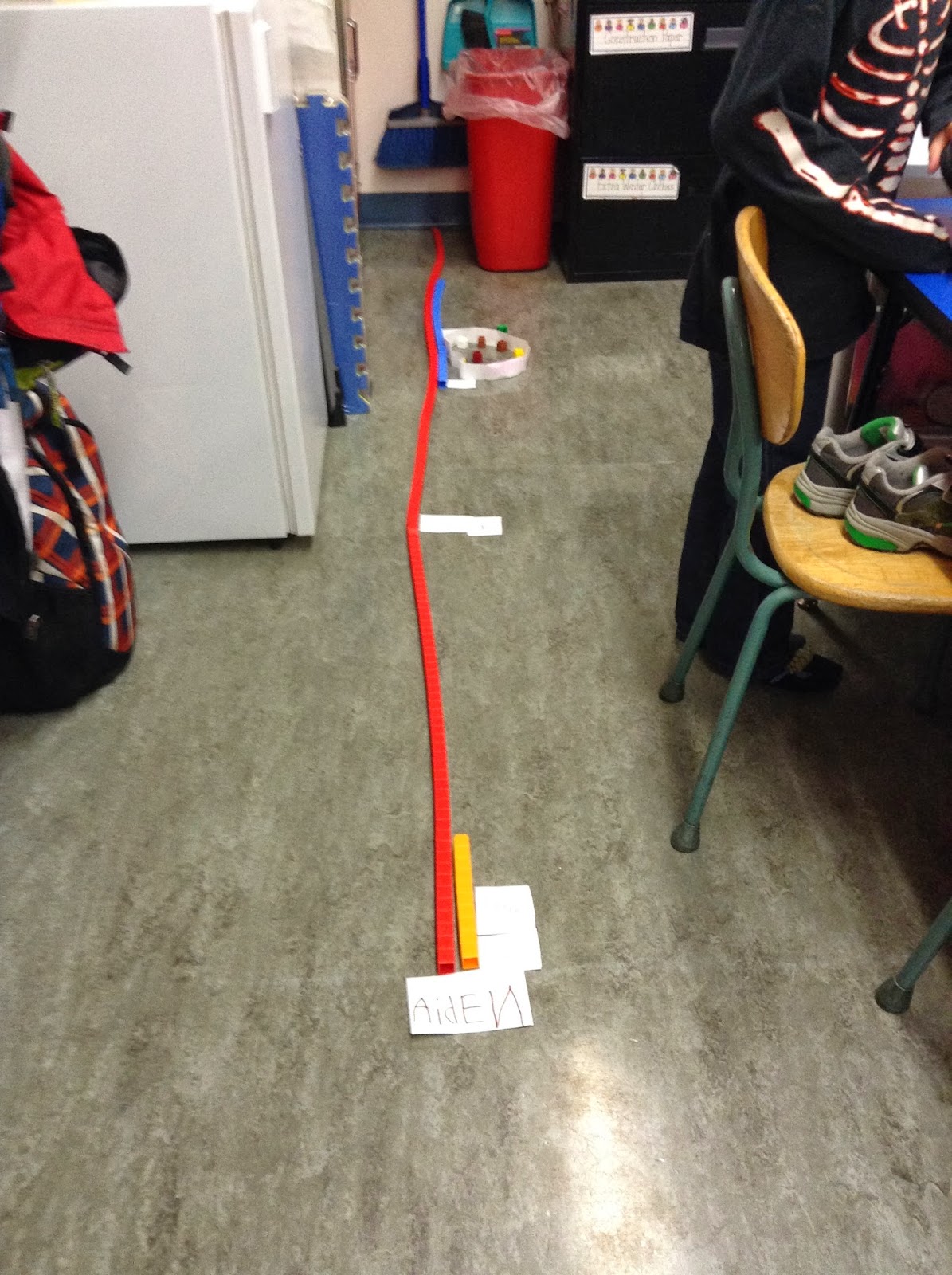
They've worked on knowing the words Compare, Build, Measure, Organize and Thinking. They've done a lot of work with building with Cuisenaire Rods (They are math manipulative used to help explain their thinking). They've built relationships, worked on building their visual memories, building equalities all to reach the goal of being able to use personal strategies to solve problems. They've measured length, height, and distance around then compared the measurements.
We'll be looking at how to measure the canoe/kayak as well as look at building larger numbers to 100 in the coming weeks.
Here are some photos of the Kayaks they built. I learned in my research that a traditional kayak is:
- The length of they kayak is 3 full arm spans long (from finger to finger)
- The cockpit is your hips plus 2 fists
- The depth of the kayak is your fist plus the hitchhikers thumb.
Interesting information, so we set out to build the length of what their kayaks would look like.
Look at how long they are. Some were very surprised. 

The length, distance around of cockpit and the depth of their kayak.

Helping each other measure.

Showing where he'd sit in his kayak.

So nicely labelled

Science/Social:
We're investigating Boats/Canoes and trying to answer the driving questions:
Why would the canoe be named as one of Canada's 7 Wonders of Canada?
• They'll work in building canoes/boats that are stable and can carry a load.
• They've tested to see what objects float and sink
• In the coming weeks, they'll learn more about Canada and the communities of the north, east and a prairie community.
I can't wait to share all that we learn about these communities.

In the coming weeks, we'll be prepping for our Halloween Party. The students will decide what they would like to do. We've also committed to decorating a Mini Christmas Tree for the Festival of Trees. I can't decide if we should be a Charlie Brown Tree or a Scaredy Squirrel Tree. I'll need to make a decision soon.

If you have any questions, please just email us. Or better yet, leave a comment so the students can learn how to respond and write good quality comments themselves.


Jul 2, 2011

The Book Whisperer


I love reading and I love books. Whenever I return from a PD day or a trip I come home with MORE books. The first thing I do on Monday during Daily 5 is share the new stories and adventures. I always joke with colleagues and my students that my husband has no idea how much money has been invested in the books in my classroom. I hope he doesn't read this post... I am forever ordering on line or from Scholastic book orders. Oy!!!
Yesterday I finished reading Donalyn Miller's The Book Whisperer. It was the first book I chose out of my huge stack of books to read this summer. I'm so happy I started with this one. She believes everything I believe about books. Kids need to read in order to become better readers. If we are not allowing them to read in school how can we expect them to enjoy books and become better readers. We know that some kids don't get read to at home or have access to going to the library/books, so it becomes our job as educators to provide opportunities for them to read. Therefore, worksheets and comprehension stories need to get thrown away. Kids need to read books, have opportunities to discuss and share. 
I'm in the process of reorganizing my classroom and I was looking at ALL of my books thinking I needed to weed through them but after reading this book, ALL of the books are staying other than the tattered and old books that can't be repaired. I've also decided to add my favourite books that I use for instruction (Kevin Henkes, Melanie Watt, Leo Leoni, Mem Fox and Barbara Reid). Why am I keeping these fabulous authors from kids? I should be ashamed.  I had to buy more shelves mind you, but it's worth it. 
I'm not going to go into a great amount of detail about the book because I want you to read it for yourself and then comment about what you thought. As I read, I kept thinking about what I wanted to change and what I wanted to keep the same. Here it is:
  1. My students usually ask if they can take home more than one book from my library to read at night and in the past I've said just one, but that will change. I think between 1 - 3 will be acceptable. Of course it will be with a promise to return them all when finished. I have to come up with a sign out system that works for little kids and it's not a huge time consumer for me. I'm open to ideas. Remember I've got THOUSANDS OF BOOKS.
  2. If they want to add a book of their choice from home to their reading box for Daily 5 it will be allowed. In the past I've said no. Why you ask? I think it was my way of wanting to have control over what they read but still allowing them choice in the classroom. I know this makes no sense but it's going to change. 
  3. I've always had them read when they are finished work and this will stay the same. I have books spread out everywhere in the classroom. Pictures will follow when it's all cleaned and organized.
  4. We have a huge chart in the classroom where I or the kids write the title of the books we've read. I'm going to have the students do this with the books they read, so they can see their totals. I can't wait to see how they respond to this. 
  5. Whenever we're waiting or in transitional times, I'll have favourite books for them to take. For example, waiting to have pictures taken, waiting in line at assembly's, they can be reading while they wait for other kids to come in. 
  6. I think incorporating writing with reading is very important and I love how Miller has her students write about a book they've read once a week and give reasons for this. It's a great way to connect with students. 
  7. I will be doing more personal reading in the classroom with the students. I'm not sure when I'm going to find the time but I'll find it. I'll model and show the book I'm currently reading. 
  8. We'll have more book sharing time. 
  9. During conferencing time, I'll read to small groups or have a student who wants to read, read to us. Only if they want to, it won't be a requirement because many students don't like reading aloud but I will encourage it if they want to.  
  10. I'm sure as the summer progresses and I do more reading I'll come up with more ideas. If you have some ideas on what you're planning on doing,  I would love to hear them.
I am looking forward to starting the year off and getting those little grade two's to catch onto reading and the love of books. I hope you take a day or a week to read Donalyn Miller's book. It's an easy read and you won't be disappointed or be able to put it down once you start. 
Happy Reading!!!
P.S. Simply 2nd Resources has created a fabulous survey for grade two student's to do at the beginning of the year.