Showing posts with label math. Show all posts

Jan 6, 2015

Covering a 3D Object

There is always someone who wants to use a ruler. I think he's doing more tracing of the side of the shape than he is with the ruler. Interesting enough, he did end up creating a net,  it was about 1 cm larger than it needed to be. 
He knows he needs to wrap the shape and not overlap the paper but he cut it too short. 
Getting close.
She's trying to hand draw the shape. Tracing isn't something that comes naturally to them. It's about measuring at least the basics of it (area & permimeter) and using what you have to help with creating that amount of space. 
This student used the other students' strategies and figured it out. She's the one in the far back corner just working her little heart out. 
She is also really close to getting it. She decided to trace the larger rectangle but then didn't trace the others. She tried to cut the shapes which is quite common with students doing this task. 
This student is so close. They've thought about each of the sides but what they don't realize is the shape only has two large rectangles, 2 skinny rectangles and 2 smaller rectangles.  

Today's task was to work on covering a 3D object but there was certain criteria they needed to follow.
1. They couldn't have any overlapping paper. 
2. They couldn't use tape or glue. 
3. The paper needed to cover all of the shape. 
From the pictures above some of them had some really good strategies. It is amazing is watch and see how they process the information and eventually come up with an answer. My goal in doing this task is tenfold. It's about so many things that I hope to reflect below. 

As I looked back on the images today and reflected again on this task (I've done this several times over the years) it is about space, and of course shape, but it's more than that. It's also about measuring, area and perimeter and knowing the shapes on the object, how large or small they are, knowing you've got enough paper to cover the whole side/object. Being flexible in your thinking, trying something new, being creative about how something worked or didn't work. It's definitely about problem solving and perseverance. It's about being entrepreneurial and engaged. I could go ove but I'm not going to. It's like a puzzle and the more I'm learning, our brain likes puzzles and problems to solve. It is such a rich task. I guess that's why I come back to it each year. 

This will lead into our investigation into building a paper box/net to hold a penguin. It also lends itself into learning there is not one way to build a net for a 3D object. Does the cube always need to make the traditional 't' shape? Or is there more than one way to build a net for any 3D object? We'll explore these questions in the going days. 


Oct 29, 2014

Our Padlet - What's a good question?

The students were introduce to Mystery Bags today but before they could find out what was in the bag they had to think about a good quality question to ask. Here are the questions they came up with. I think some of them worked hard to think about questions that did not require a yes/no answer. Scroll along to see the rest of the document. 


Sep 8, 2014

Welcome Back!

I figured if I wanted you to come to the blog I better post some stuff for you to read. We got through the first week of school, boy was I tired Friday, and we're into the second week. 
Your child is settling in and learning the classroom routines. Last week we looked at translating our name pattern's into actions, sounds and on paper and with colour. More work is going to be needed. 
This week we'll be working on building routines for Reader's Workshop and Word Work. We are up to 8 minutes of reading stamina. Yay!!! You may have heard that we collected rocks today for our Rock Investigation. We'll be working on Perseverance, tomorrow you can ask your child what this word means. In our rock unit, we'll be learning how to sort, work with mass, learn how to persevere and build a plan for breaking rocks. Don't tell them about this because it's a surprise for the end of the week. In math we're working on learning how to subitize (when you look at a collection you can identify it without counting) and seeing the parts inside the whole number. For example, the whole number is 6 but the parts might be 3 + 3, 2 + 5, etc. 
In writer's workshop they are learning to write from their own ideas and begin to organize their writing on a 5 Finger Planner. 
Looking forward to posting some photos. 

May 5, 2014

How Do I Learn?

Have you ever asked your students to answer this question?  You might want to give it a try, I think you would be pleasantly surprised by the answer. I know I sure was.  A couple of weeks ago, I asked my grade twos this question (It comes from the Inspiring Education document from the Alberta Government) and I wanted them to video tape each other and post it to their blogs (Yes.. you read that correctly, I have my students video tape themselves all the time). If you are interested in going to take a look here are the videos on How Do I Learn
After reviewing the video, I picked those I felt the students needed to hear because of what was said. Here is what the students said: 


We then talked about, what evidence shows your learning? I was blown out of the water by what these little people came up with.  Yes... all my reinforcing of vocabulary has paid off.

You might want to try asking your students, how they learn and have a conversation about it one class.  It think it would make for an interesting discussion.


Jan 13, 2014

Math Reasoning

Here is an example of what math reasoning sounds like. The first time he was explaining it to me, he was far clearer and didn't get confused. The students were trying to figure out whether 33 groups of 3 penguins worked. The initial problem was trying to figure out how many ways 100 penguins could be organized into equal groups.
He knew you could reverse 33 groups of 3 penguins into 3 groups if 33. From there he added the 33's together to make 99. He has one penguin left over so this combination can't work. 
Math reasoning is a huge component of our math curriculum.  My goal in grade two is to get them to reason why a strategy or answer will or will not work. When this happens it's truly amazing to hear them thinking and being logical as to why it does or doesn't work. This boy clearly has mathematical reasoning for this particular problem. He understood that by switching or reversing the combinations, you could find other combinations.


We want them to be thinking about the reasons why it should work because of what the numbers can and can not do. This particular student isn't doing gobs and gobs of math worksheets, instead they are working in a problem based math classroom where it challenges him to think and reasoning. I love it when this happens, now I just need them all to do this :-).


Jan 8, 2014

How many ways can you organize 60 penguins in equal groups?


As a class we had to find out how many different ways 60 penguins could be organized. When we first got started we were stuck on 2 or 3 ways. Ms. Brown told us to go and get Unifix cubes (blocks), this sure helped a lot. It worked much better for us. We then worked as a class to find 12 ways to organize the 60 penguins. We were surprised at all of the different ways. 

Oct 20, 2013

What Are We Up To...

It's been a very busy 2 months of school and the days are flying by. I can't believe Halloween is next week...please save me know. Here's what's been happening in 2B.

Writer's Workshop:
In September the kids focused in on writing their ideas down. Some are still working on this while others are moving on to use Organization in their writing. They are learning how to use question leads and sound leads to create Bold Beginnings.
• They'll be moving onto learning how to write Mighty Middles and Excellent Endings.

Word Study:
They've learned the routines and activities we'll do while Ms. Brown works with small groups to teach them their sounds.
• Our first test is on Tuesday. You won't know how you did until Wed.
• New words will come home on Wednesdays - I think we'll take 2 weeks to do this next set of words again because we miss school on Friday and Halloween activities the following week.

Reading/Daily 5:
They've built up their stamina for being able to read independently for 20 minutes. I've finished the testing I needed to do and now I get to conference with students. They'll be picking a reading goal and strategy to work on during Daily 5 time. I can't wait to meet with each of them.
• Several reading strategies have been introduced and they have all been sent home. More will come home so please save them.
• They are working at building their stamina with Reading to Someone. Work on Words and Listening to Reading will be coming up next.

Math: (Ms. Brown's favourite subject to teach :-))
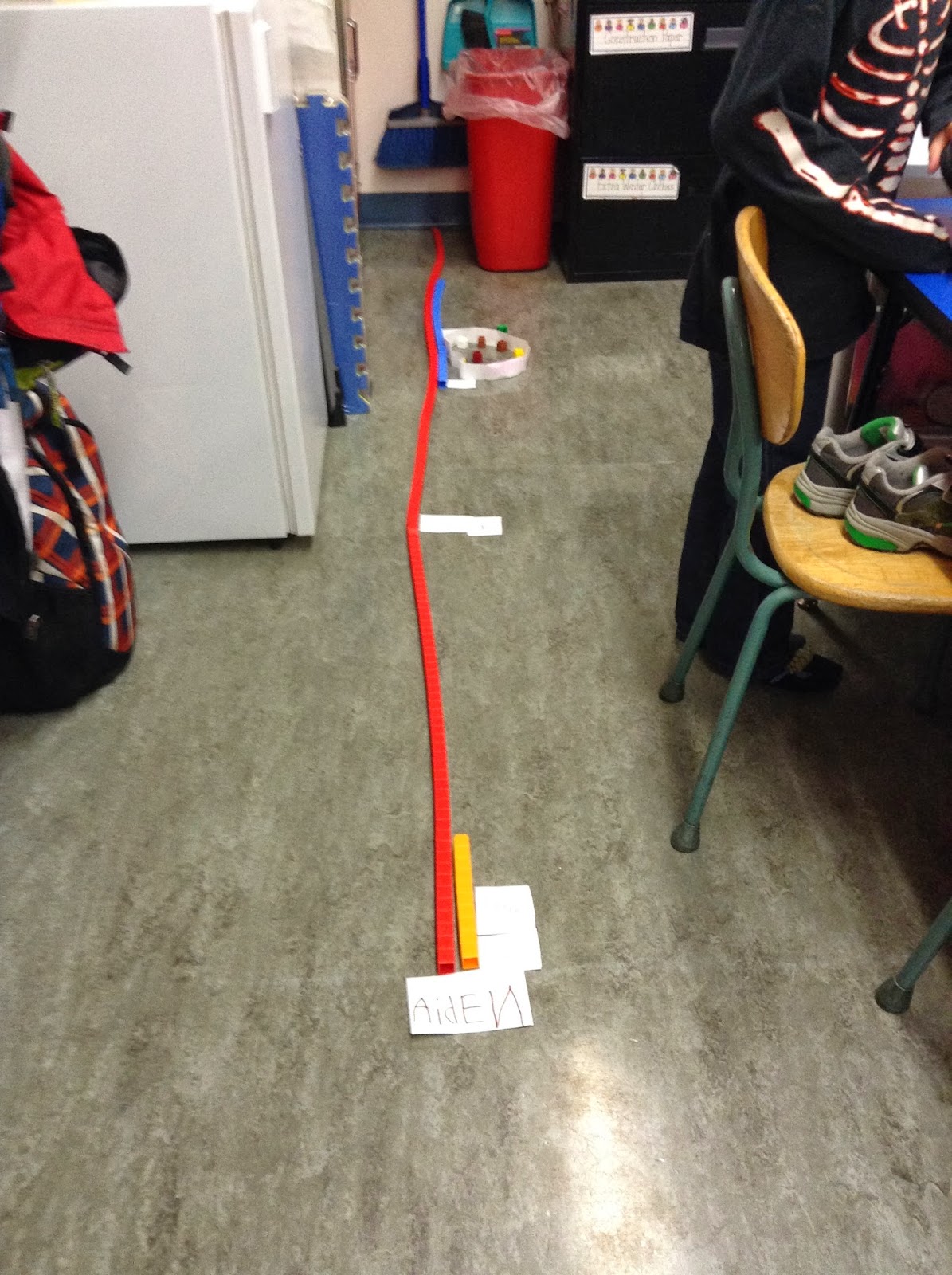
They've worked on knowing the words Compare, Build, Measure, Organize and Thinking. They've done a lot of work with building with Cuisenaire Rods (They are math manipulative used to help explain their thinking). They've built relationships, worked on building their visual memories, building equalities all to reach the goal of being able to use personal strategies to solve problems. They've measured length, height, and distance around then compared the measurements.
We'll be looking at how to measure the canoe/kayak as well as look at building larger numbers to 100 in the coming weeks.
Here are some photos of the Kayaks they built. I learned in my research that a traditional kayak is:
- The length of they kayak is 3 full arm spans long (from finger to finger)
- The cockpit is your hips plus 2 fists
- The depth of the kayak is your fist plus the hitchhikers thumb.
Interesting information, so we set out to build the length of what their kayaks would look like.
Look at how long they are. Some were very surprised. 

The length, distance around of cockpit and the depth of their kayak.

Helping each other measure.

Showing where he'd sit in his kayak.

So nicely labelled

Science/Social:
We're investigating Boats/Canoes and trying to answer the driving questions:
Why would the canoe be named as one of Canada's 7 Wonders of Canada?
• They'll work in building canoes/boats that are stable and can carry a load.
• They've tested to see what objects float and sink
• In the coming weeks, they'll learn more about Canada and the communities of the north, east and a prairie community.
I can't wait to share all that we learn about these communities.

In the coming weeks, we'll be prepping for our Halloween Party. The students will decide what they would like to do. We've also committed to decorating a Mini Christmas Tree for the Festival of Trees. I can't decide if we should be a Charlie Brown Tree or a Scaredy Squirrel Tree. I'll need to make a decision soon.

If you have any questions, please just email us. Or better yet, leave a comment so the students can learn how to respond and write good quality comments themselves.


May 9, 2013

How Many Band-Aids Tall is Your Giant?

The kids worked on trying to figure out how tall the giant was in Band-aids? Here's some of the work they do during math and problem solving. 


Feb 8, 2013

Finding Expressions

Good Morning All!
I am excited to share some of our math thinking we've been doing this week. I have to say, I love technology, especially when it works and having WiFi in my room. 
I asked the student students to bring in their iPod's yesterday so they could video tape each other finding expressions in their images they've created. 
Here is a really nice example of Mackenzie finding a mistake she made, and if you look really closely you'll see I marked the mistake correct. Oops!!!
She is showing you how she can see the expression 60 - 3 (she's written 60 - 4) in the drawing she's created. 


You'll see she realizes she's made a mistake and pauses. I think she takes some time between videos to think about her mistake, work it through in her brain and re-records her thinking. Here she is.


I LOVE that she realized her error and then they redid the recording. She's very confident in her thinking and retelling of what she's done. Today, I feel like we are getting some place, tomorrow, well... we'll see. I'll take what I can get.
Have a great weekend everyone. If you have some thoughts on her thinking or you're wondering why I'm having them find expressions in the images, drop me a line.

May 18, 2012

My Other Blog

Hello Everyone,

I've created another blog that will focus on how I teach math and the connections my students are making and are not making. The blog will have a strong focus on math. If you are at all interested in learning how to help your students build number sense or you just want to lurk around and gain some ideas please come on over to The Math Whisperer. I'm starting the dialogue, I just need you to contribute more of your ideas.

Looking forward to the conversations.

Nov 30, 2011

Final Task from One is a Snail Ten is a Crab Problem

Dredon & LindenJaylen & ConnorKaiya & EmmaSeth & MaysenBrooke & KassyTeegan & Erika
Maddy & MicaelaJerry & CharlieAmber & AlyssaEllie

We've been working on a problem from the book One is a A Snail Ten is a Crab (great book for numbers and decomposing them).

The problem was:
If you can only use snails and dogs to make 25 feet, how many different ways can you do this?

The answer is 6 combinations but we took it a step further and organized our thinking to see if we could find patterns. This helps them know if they have all the combinations to the problem.
Organizing of data is also a skill students need to have in all subject areas. If their data or results are organized it becomes easier to read, know if you've gotten all the right information or finished the problem.

There was a tremendous amount of number and problem solving in this task.
1.  They had to understand the problem, work with 25 blocks, realize that there is more than one answer, know if they were finished and work with another person.
2. They needed to understand what organizing their work meant. We'd done a lot of work with organizing our writing but it didn't always transfer over into math.
3. They were then expected to find a pattern. When I asked them what a pattern was, I got ababababab, etc. The standard answer. To be able to find an increasing or decreasing pattern in all of this data was a challenge. They could see the dogs increase by one dog but they were not thinking that it increased by 4 feet. I'm not sure they really get that part of it but for right now the task was about organizing their answers to see if they can find a pattern and know if they got all the combinations.
4.  Organizing of the blocks was challenge, some were stuck on "How many they needed", or only making one combination (speaking of this word, it was difficult for them to figure out what this meant. The more I talked about it the more they figured it out). 
5. They had to listen to one another and take suggestions.
6. I took pictures the whole way through so they could see what others were doing. We compared pictures and talked a lot about how do we read the data and where they were in the process (if you go to the flickr site you will find the beginning photo's).
7. The manipulating of the materials and following instructions was hard for some of them, but they worked through it to come to an answer.

8. They were constantly counting or doing some kind of adding to figure out if each combination made 25 feet. Practical and world math.

Problem solving is so worth the time and effort. There was no paper and pencil work, other than writing on their white boards. I have data to help influence my instruction of more number work and other problem solving.

We've got a long way to go, but I know it will get easier the more we do. If you have any questions please let us know and we'd be happy to answer them.

Sep 22, 2011

Building Giants

The problem the students were working on was: 
There was a giant who was 6 cubits and a span tall. How tall do you think the giant was? We didn't have this problem on a piece of paper for the students to read but a good discussion was had about tall and big as well as what a cubit and a span was. It was also a great time to have a conversation about thinking and what it looks like.  If you want to know please message me & I would be happy to tell you. 
We sent the students to work when they we thought they were ready. Some had confused faces but they are kids and want to please. This problem was done the second and third day of school. Yes, you read that correctly. They could use whatever they wanted, paper, blocks, etc.
We got a variety of strategies and different looks to the giant. I'm showing this one because when we were finished we compared the strategies to each other. We didn't get to these two but wouldn't it be interesting to compare how these two examples are similar and different. What would your students say? 
We worked through several different measuring tasks. One was to measure their height with the names. It's an activity I use from the book Chrysanthemum. From this activity we compared the height of the giant to the height of ourselves. These two girls quickly came to a conclusion. They built the giant, you can see the different colors (it's their cubit) and then measured their heights.
The eraser is marking how tall they were.
She is then measuring the left over height of the giant. They discovered the giant was a cubit and a span taller.
This group built their own heights. Look at the amount of work they put into this task. The green blocks are the giant and the other set of blocks are their heights. The organization is fabulous.


May 11, 2011

Second Try

Today the students got a second try at building another ruler. I had a sub do this and to be honest I wasn't sure what I was going to find when I returned to school. I was pleasantly surprised by the results. The students used the feedback they got from each other based on the criteria they came up with to modify and build a better looking ruler. Here is a photo of the final rulers displayed on the bulletin board.

May 9, 2011

Band-Aids!

You might be wondering what we're doing with Band-Aids in the classroom. It's a very fun investigation into measurement and problem solving. This last week we read the poem Band-Aids by Shel Silverstein. If you've never read I highly recommend you do. It's sooo cute. The task was to figure out how many Band-Aids the boy put on his body. They could use anything to help them but most used paper and pencil. The point was to get them thinking about personal strategies. Here are a couple who really represented their thinking well. I know that some of them have added incorrectly and they've got the wrong answer. I'm more concerned that they've got a strategy than the correct answer. Let me know what you think about some of the strategies the kids are using. Do your kids use some of the same ones?


I'm not sure how to get my pictures side by side. They keep shifting on me. I'll figure it out.  I'm always trying to get teachers to work from a problem solving approach. So I want you to really notice how much work these kids have done. They are using a lot of mental math and practicing basic facts at the same time. Yes there are some number reversals but I'm not really worried about that because they are thinking. 

Today we talked about the criteria a ruler had to have. The kids decided that a ruler needed to have:
  1. Numbers and they needed to be either below the line or beside it. You couldn't have the numbers in both places on the same ruler. 
  2. The units needed to be the same throughout the ruler.
  3. The units couldn't be overlapping or far apart. They had to be close together. 
  4. It needs to have a straight edge. 
  5. The lines need to be the same distance apart. 
Here are some of the rulers they created today. Tomorrow they are going to evaluated each others rulers and give some feedback then recreate another ruler using a different size Band-Aid. (I know some of them are incorrect but don't we always say we can learn from a mistake?)
Following most of the criteria.

Had a discussion of why 0 - 10. He let me know that there were 10 cm between each of the numbers. Hmmm!

Great problem solving of how to keep the adding machine tape from curling up.

Really like his strategy of iterating.

I wonder where they are thinking zero is?

Some misunderstandings...we'll get it cleared up soon.


Band-Aids are side by side.

Actually measuring. Is the Kleenex box really 25 Band-Aids long?

I think our work with an open number line is transferring into this activity. Does it make sense that this box is 40 Band-Aids long? Again some misunderstandings. 

It's all a learning process. It's unbelievable how their thinking and learning will develop the more time they build a measuring tool/ruler.
Hope you enjoyed and learned something new.